


Agency Pricing: Flat Fee vs. Percentage of Ad Spend Explained
Key Insights
- Flat fee vs. percentage of ad spend: which one is cheaper depends entirely on your spend level, not which model sounds better.
- The crossover point tells you exactly where that switches: flat monthly fee ÷ percentage rate = the spend level where both cost the same.
- Percentage pricing means the fee goes up whenever your spend goes up, whether or not that extra spend actually works.
- Growth Loops publishes flat pricing ($2,750, $3,875, or $5,825 a month) before you ever talk to anyone.
When you’re looking for a PPC management agency, one of the first things you’ll notice is that pricing doesn’t look the same from one quote to the next. Asking a few agencies for a quote on the same scope of work is a natural next step, and it usually turns up three different pricing setups: one charges a flat monthly fee, another takes a percentage of your ad spend, and a third charges a base fee plus a bonus. Add a freelancer or an AI tool into the mix, and you end up with a pile of invoices that don’t compare to each other at all.
The real question: why does the same work end up costing such different amounts, and how do you actually compare the quotes? Just picking between percentage of spend and a flat fee doesn’t fully solve that. Even inside one agency, PPC pricing and social pricing often don’t follow the same logic.
Here’s what both models actually charge, the math you can calculate yourself, and a third pricing option that skips the comparison problem instead of trying to win it.
The Two Main Pricing Models
Percentage of Ad Spend
An agency charges a set percentage of whatever you spend on ads each month. If you spend $8,000 on Google Ads and the agency charges 15%, the management fee is $1,200 that month. Spend more, and the fee rises with it. Spend less, and it falls.
According to a 2025 industry pricing guide, the typical range runs 10% to 20% of monthly ad spend (AgencyAnalytics, published July 2025). Exact quotes vary by agency and scope.
There’s a simple reason smaller accounts often pay a higher percentage: setting up tracking and reporting takes roughly the same work no matter how big your budget is.
That’s also why a percentage quote can hide a minimum fee. If an agency says 15% but also has a $1,500 monthly minimum, you’re not really paying 15% until your spend passes $10,000. Below that, you’re paying the minimum, whatever percentage that actually works out to.
Flat Fee
An agency charges one fixed amount every month, agreed on ahead of time, no matter what you spend on ads. The number is based on the work involved (which platforms, how many campaigns, how often you get reports), not on your ad budget.
The tradeoff: flat fees are almost always custom numbers. There’s no public price list to check yours against, so the only way to know if $3,000 a month is fair is to ask a few agencies and compare what each one actually includes.
Flat fee is also more common than calling these “the two main models” suggests. Credo, a marketplace that matches businesses with vetted marketing agencies, surveyed 146 PPC firms and found 82.68% bill flat-fee retainers, compared with 12.85% billing a straight percentage of spend (last updated July 2022). Many agencies actually use both: a flat base fee plus a percentage on top for bigger accounts, which is closer to the hybrid model covered later in this piece.
Why Percentage Pricing Creates a Conflict of Interest
Here’s the plain truth about percentage pricing: the agency’s fee goes up every time your spend goes up, whether that extra spend works or not. This isn’t about any agency acting in bad faith. It’s just math. At a flat 15% rate, going from $20,000 to $40,000 a month doubles the agency’s fee from $3,000 to $6,000, even if that extra $20,000 barely performs.
That’s the real issue: percentage-of-spend pricing creates a built-in conflict of interest, since more spend always means more fees for the agency, whether or not that spend actually works. A flat fee removes that conflict, since the fee stays the same no matter how much you spend.
That doesn’t make percentage pricing the wrong choice every time. It can make real sense for small or unpredictable budgets, since it automatically drops in slow months instead of charging a flat rate sized for your busiest month.
The Crossover Point: A Number Worth Calculating Yourself
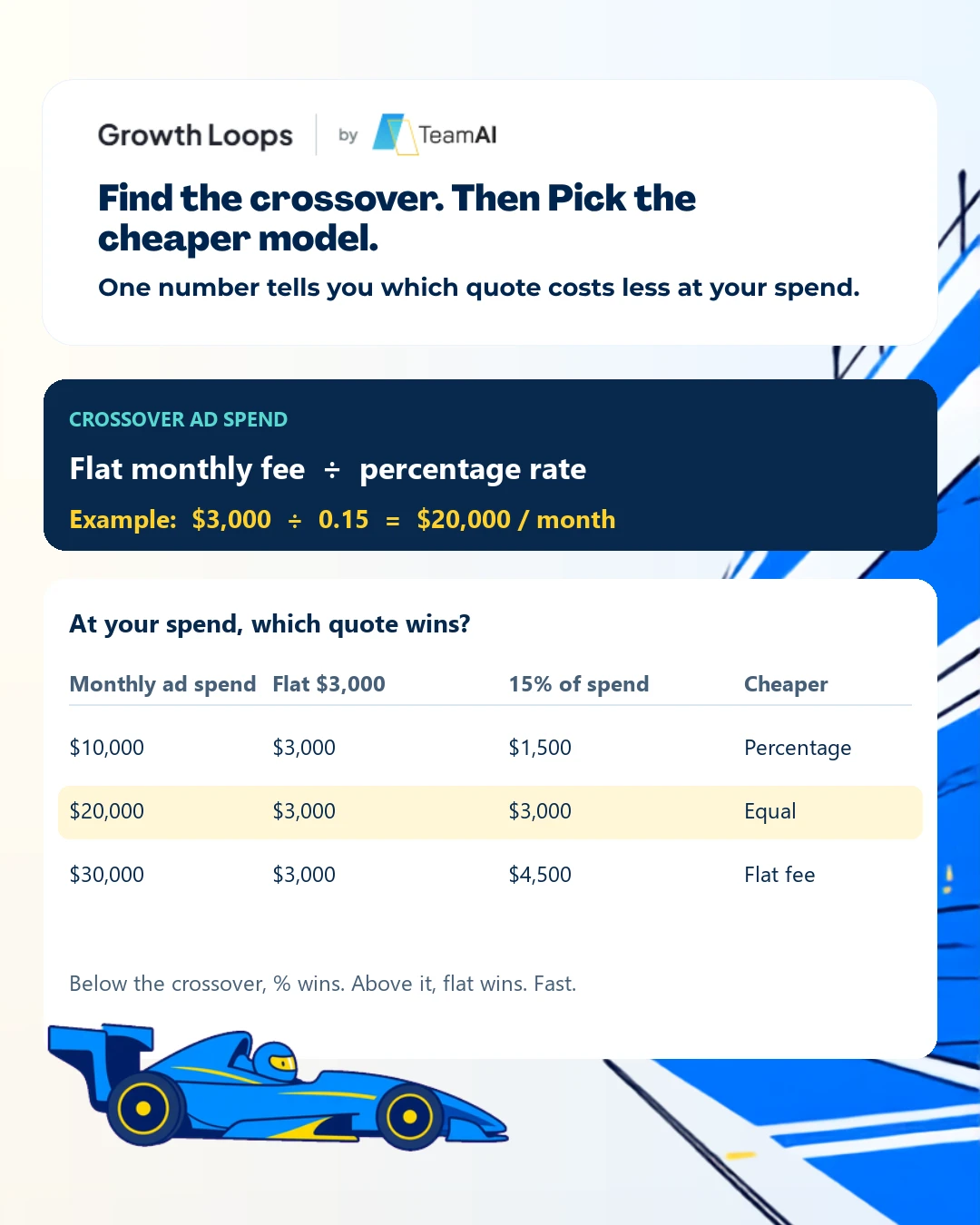
If you’re choosing between a flat fee and a percentage quote, there’s one number worth working out before you sign anything: the spend level where both cost exactly the same. Below that level, percentage pricing is cheaper. Above it, flat fee is. Here’s the formula:
Crossover ad spend = flat monthly fee ÷ percentage rate
Say one agency quotes a $3,000 flat monthly fee, and another quotes 15% of ad spend. Divide $3,000 by 0.15, and the crossover point is $20,000 in monthly ad spend.
| Monthly ad spend | Flat fee | 15% of spend | Cheaper option |
|---|---|---|---|
| $10,000 | $3,000 | $1,500 | Percentage |
| $20,000 | $3,000 | $3,000 | Equal |
| $30,000 | $3,000 | $4,500 | Flat fee |
Under $20,000 a month, the percentage quote costs less. Above it, the flat fee wins, and the gap grows fast as spend goes up. This is just math, nothing proprietary, and you can run it yourself in under a minute once you know both numbers.
One catch: this only compares the management fee. A percentage quote with a monthly minimum changes the math below that floor, and neither number tells you whether the ad spend itself is actually working.
What three quotes for the same scope can look like
Here’s a made-up example, not a real quote or a real client’s RFP: a mid-market B2B company spending about $25,000 a month on Google Ads, with the same scope of work quoted by three agencies (management, reporting, and creative variants).
| Quote | Structure | Fee at $25k spend | The catch |
|---|---|---|---|
| Agency A | 15% of spend, $1,500 minimum | $3,750 | Fee rises automatically if spend scales; landing pages billed extra |
| Agency B | $3,200 flat retainer | $3,200 | Custom number; no public rate card to check fairness |
| Agency C | $2,000 base + $40 per qualified lead above 30 | Variable ($2,000+) | Baseline and “qualified” definition negotiated privately |
At $25,000 in spend, Agency B’s flat fee beats Agency A’s percentage on cost alone ($3,200 vs $3,750). The crossover point for a $3,200 flat fee against 15% works out to about $21,333. None of that tells you which scope is real, what extras are hidden, or who’s actually accountable if results slip.
Where Hybrid Pricing Fits
A third setup mixes a base fee with a performance bonus. The agency charges a fixed monthly amount for the ongoing work, then adds a variable fee tied to a result, like a bonus for every qualified lead above a set number, or a share of revenue above an agreed line.
Hybrid pricing isn’t quite either pure model. It’s not a flat fee, since part of the cost still changes. And it’s not a percentage of spend, since the variable part is tied to a result you actually care about, like leads or revenue, not to how much you spent on ads.
Here’s what that looks like: an agency charges a $2,000 base fee, plus $50 for every qualified lead over 40 in a month. If the account brings in 55 leads, that month’s total is $2,000 plus $750 (15 extra leads at $50 each), or $2,750. The base fee covers running the account. The bonus rewards results, not just spending more money.
Here’s the limitation, stated plainly: hybrid pricing is not published or tiered pricing. Setting one up still takes a custom conversation to agree on the baseline, how results get measured, and the split.
Two agencies both offering “hybrid pricing” can structure the baseline, the trigger, and the bonus rate completely differently. That makes hybrid quotes just as hard to compare as flat-fee quotes. There’s no rate card to look up for either one.
The Third Option: Published, Tiered Pricing
Every model covered so far has the same gap. Even the most transparent percentage or flat-fee quote still ends with a sales call before you see a real number. Hybrid pricing doesn’t fix this either, since it needs the same custom negotiation. None of the three gives you a price, and someone named accountable for it, before you’ve talked to anyone.
That gap is real. Clutch, a platform that verifies client reviews for service providers, surveyed 451 people who’d made a B2B purchase (published February 2020) and found 25% said clear pricing was the single most important thing on a company’s website, ahead of case studies or client reviews. Buyers want a number they can act on, not a form to fill out first.
Growth Loops works differently: published tiers, a TeamAI agent team running every day (5 on Starter, 7 on Growth, 9 on Scale), and a named WebFX Revenue Marketing Specialist accountable for what ships. The full tier breakdown is public on /pricing/ before you ever talk to anyone:
| Plan | Monthly price | What it covers |
|---|---|---|
| Starter | $2,750 | 5 TeamAI agents (managed Google Ads and core paid stack), monthly specialist talk time |
| Growth | $3,875 | 7 agents, expanded paid social, bi-weekly specialist talk time, Visibility Analyst (AI search visibility diagnosis) |
| Scale | $5,825 | 9 agents, broader paid social scope, weekly specialist talk + sign-off, full Growth visibility scope plus deeper competitive visibility work |
Every plan also includes a one-time setup fee of $2,500 (or $750 with annual prepay) and 10 Nutshell CRM seats. SelectROW, a WebFX real estate and construction client, saw 300% more PPC lead forms from managed Google Ads. That’s WebFX managed-paid proof on a published account, not a claim that SelectROW ran on Growth Loops tiers.
This isn’t just a cheaper flat fee. It’s genuinely different from everything above: the price is published before a conversation starts, and having a named specialist review what goes live doesn’t go away just because the number is public. In practice, that changes the sales call. Your Revenue Marketing Specialist spends less time defending a number nobody can check, and more time matching your channels, markets, and review needs to Starter, Growth, Scale, or Platform.
To be honest about where this doesn’t work: if you’re a small local business spending $3,000 to $5,000 a month on ads, a percentage quote in the 10-20% range would likely cost less in real dollars than Growth Loops’ $2,750 Starter tier. Published pricing isn’t a claim to being the cheapest at every spend level. It’s a claim to knowing your number before you talk to anyone, and having a named specialist accountable for what ships, no matter how big or small your account is.
How to Actually Evaluate a Pricing Quote
Whatever proposal you’re holding right now, run it against these five questions before you compare it to anything else:
- Does the fee move with ad spend, and at what rate? If it’s percentage-based, get the exact rate and whether it changes at different spend levels.
- What’s included, and what costs extra? Creative work, landing pages, and detailed reporting are common places where a low headline price hides extra costs.
- Is the number published, or does it require a conversation to get? A quote you can’t verify against anything public is a quote you’re taking on faith.
- Is there a separate setup or onboarding cost? Ask for the exact figure and what it covers.
- Is there a minimum monthly fee? A percentage quote with a high minimum can cost far more than the stated rate suggests at lower spend levels, since you’re really paying a flat fee in disguise until your spend crosses that line.
Three Questions Worth Asking Before You Sign Anything
How is this different from a traditional retainer? A traditional retainer, flat or percentage-based, is still a custom number you negotiate. Ask whether the price you’re seeing is genuinely published somewhere you can check, or whether it’s a starting point for a longer conversation.
What happens if results lag? Ask how often someone actually reviews the account and what triggers a change. A monthly check-in and a weekly one produce very different response times when something isn’t working.
How fast does a specialist actually respond? This is the same cadence question from a different angle: not how often the account gets reviewed on a schedule, but how quickly you hear from an actual person when you need one.
Get Started With Growth Loops
You now have a real way to compare any two quotes in front of you, including the one number you can work out yourself. The honest next question is whether there’s a model that skips this comparison problem entirely, instead of just winning it.
Growth Loops publishes its pricing before you ever talk to anyone. You can see exactly what Starter, Growth, and Scale include and what each one costs, and a named WebFX Revenue Marketing Specialist stays accountable for what ships at every tier, checking in as often as your plan calls for. Being transparent about price doesn’t mean giving up a real person owning the account.
See Growth Loops’ published pricing and book a strategy call to find out which tier fits.
FAQ
What’s the actual difference between flat fee and percentage of ad spend?
A flat fee is a fixed monthly amount that doesn’t change with your ad budget. Percentage of spend rises and falls with how much you spend on ads that month.
Which model is cheaper?
It depends entirely on your spend level. Divide the flat fee by the percentage rate to find your crossover point. Below that spend level, percentage costs less. Above it, flat fee does.
Is percentage-of-spend pricing inherently bad?
No. It creates a structural incentive for the fee to rise with spend regardless of efficiency, but it can genuinely suit small or highly variable budgets better than a flat rate would.
What is hybrid pricing?
A base retainer plus a variable fee tied to a result, like a bonus per qualified lead or a share of revenue above a baseline. It still requires custom negotiation, unlike published tiers.
Does Growth Loops charge a percentage of ad spend?
No. Growth Loops runs on published, flat monthly tiers, Starter, Growth, and Scale, that don’t change based on how much you spend on ads. See published pricing.
Does Starter include Visibility Analyst?
No. Visibility Analyst (AI search visibility diagnosis) starts at Growth. Starter includes five TeamAI agents, managed Google Ads work in the core stack, and monthly specialist talk time.