


Marketing Agency Checklist for Small Business: The Six Questions to Ask Before You Sign

Key Insights
- Across 500 small business owners surveyed for the 2025 SMB Marketing Report, 40% ended up switching agencies or dropping the arrangement, and 56% of that churn happened inside the first six to 12 months, with lack of ROI the reason most gave.
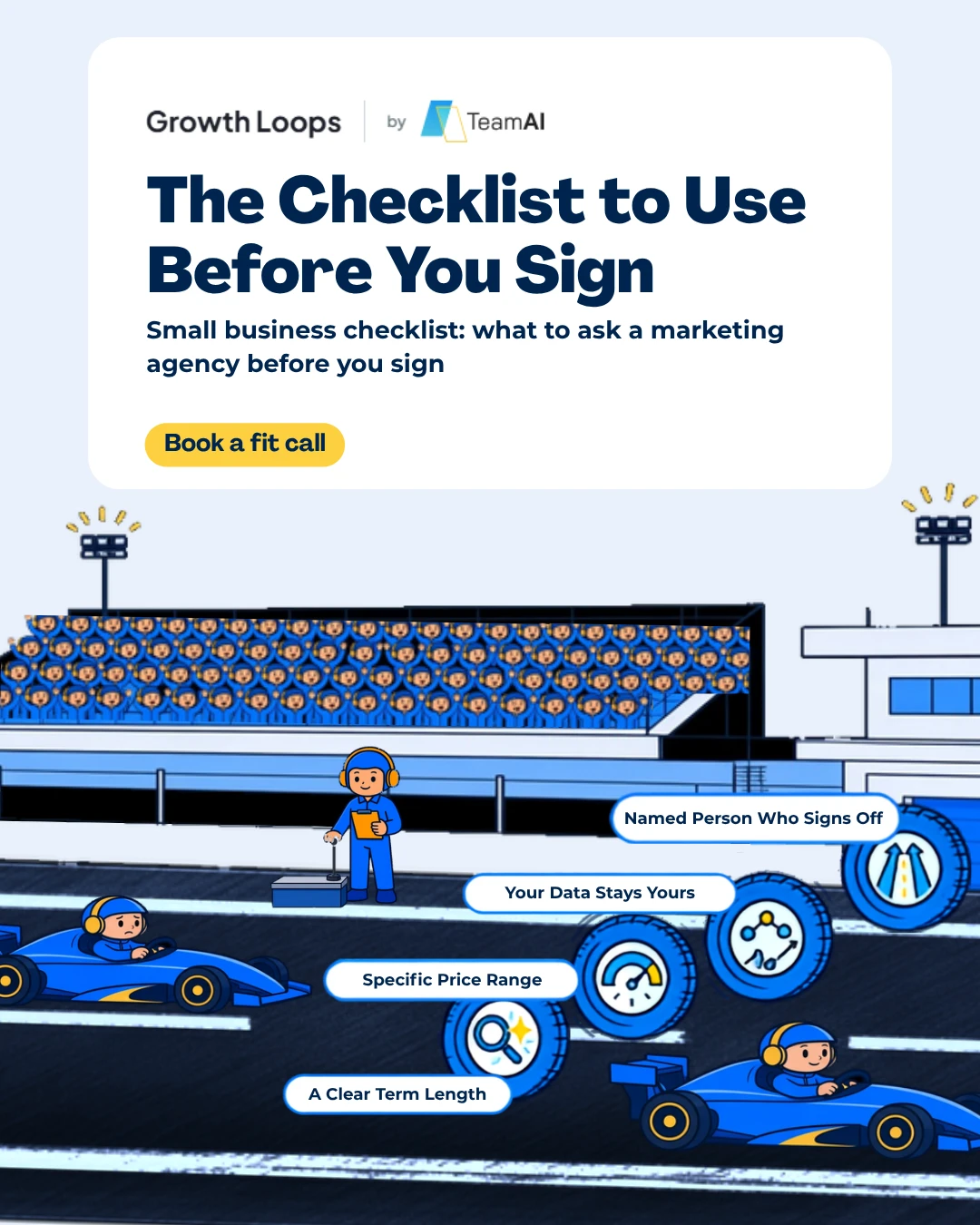
- Six questions, asked before you sign, each have a specific, checkable answer rather than a reassuring one: fit honesty, named accountability, data ownership, contract terms, pricing transparency, and contact cadence.
- “We’re a true partner” is reassuring. “You keep your account and your data if you leave” is checkable. A defensible agency should answer all six without hesitating.
- None of the six red flags below is disqualifying alone. More than one at once, or defensiveness instead of specifics when you ask, is what should make you pause.
- Growth Loops answers all six with a named WebFX Revenue Marketing Specialist who signs off on what its TeamAI agents recommend, published tiered pricing, a 12-month term with no early-termination fee, and fully portable account data.
A recent 2025 SMB Marketing Report, which surveyed 500 small business owners across a cross-section of U.S. industries, found 40% end up switching agencies or dropping the arrangement altogether, and 56% of that churn happens inside the first six to 12 months. Lack of ROI is the reason most of them give. The same report found the services that get cut first are social media management, paid search, and web development, and it’s not a coincidence that those are the services a sales pitch spends the most time on.
That gap between the pitch you hear on a sales call and what actually happens once you sign is what this checklist closes. Six questions, asked before you sign anything, each with the answer a defensible agency should be able to give you without hesitating. You can ask most of these in a single sales call without slowing anything down, and a genuinely confident agency will treat the questions as normal rather than as an obstacle.
Every one of these questions has a specific, checkable answer, not a reassuring one, which is the real test. “We’re a true partner” is reassuring. “You keep your account and your data if you leave” is checkable. If an agency’s answer to any of these lands closer to the first than the second, that’s the information, not a reason to ask again more politely.
Will They Tell You If You’re Not a Good Fit?
Ask directly: would you turn down my business if I’m not a good fit for what you do? A sales call is built to close, and closing is not the same job as flagging a bad fit, so fit is not something a pitch has an incentive to raise on its own.
- Ask this: Is there a business size, budget, or industry where you’d tell a prospect to look elsewhere?
- Red flag: A sales call that never once raises size, budget, or scope as a reason the fit might be wrong, and instead finds a way to make every business sound like a good candidate.
- Good answer: A specific range where the agency’s model actually works, stated plainly, along with a willingness to say when a prospect falls outside it.
Growth Loops states this directly rather than leaving it implied: if Growth Loops isn’t the right fit, they’ll tell you. That includes telling a prospective client when their current marketing is already working well enough that a managed program wouldn’t add much, or when their business genuinely sits outside the range a managed paid-marketing program is built for.
It’s a rare thing for an agency to say out loud, since a sales process built around closing has no built-in incentive to say no. A prospect who hears “we might not be right for you” before signing anything is hearing something that costs the agency a sale in the short term, which is exactly why it’s worth taking seriously when you actually hear it.
Who’s Accountable When a Campaign Underperforms?
One named person should be able to answer for a campaign, not a team description that lets responsibility shift from person to person when something goes wrong.
- Ask this: Who signs off on what actually goes live, and who do I call directly if something isn’t working?
- Red flag: No single named point of contact, or one who rotates every few months, leaving you re-explaining your business every time performance dips.
- Good answer: One named person, tied to your account specifically, who reviews the work and is reachable when you need them.
At Growth Loops, that’s a named WebFX Revenue Marketing Specialist. TeamAI agents handle the recurring execution, bid work, creative variants, reporting, but the specialist is the one who reviews what agents recommend and signs off before anything ships. Growth Loops spells out the role plainly: that person is accountable for what goes live, picks up the phone, and tells you the truth. The specific detail worth checking with any agency you’re vetting, AI-assisted or not, is whether that accountability sits with one person you can name, not with “the team” or “the system” as a whole.
Who Owns Your Ad Accounts and Data if You Leave?
Google’s own documentation confirms an advertiser’s account remains their own property, and removing a manager account’s access doesn’t touch the account or its campaigns, so handing over ad account access is the baseline any agency has to clear. What separates agencies is whether they hand over the performance history and testing decisions that took time to build, or quietly keep it.
- Ask this: If I leave, do I keep my ad accounts, my historical performance data, and everything you’ve learned about my campaigns?
- Red flag: Ad accounts built and owned under the agency’s own login, or a data-handoff process the agency can’t describe when you ask.
- Good answer: A clear statement that your accounts and your data are yours, portable, and yours to take on the way out, no exceptions carved in.
Growth Loops answers this directly: if you leave, your FXClient Brain is fully portable, and you take it with you. That’s the FXClient Brain, the accumulated record of what’s worked and what hasn’t across your account as FXBrain applied it to your specific business, not just the raw ad platform access.
Ask any agency you’re considering for that same specificity, not a general assurance that “of course you own your data.”
What Happens After Your Contract Term Ends?
A clear term length with a clear description of what happens next, and no undisclosed penalty for leaving, is what separates an honest contract from one where the real terms surface only when you go looking for the exit.
- Ask this: What’s the minimum term, and what happens once it’s up? Is there a fee to leave early?
- Red flag: A long minimum term paired with a narrow, easy-to-miss cancellation window, or an early-termination fee that only comes up once you ask to leave.
- Good answer: A clear term length, a clear description of what happens after it ends, and no penalty for leaving that wasn’t disclosed upfront.
Growth Loops’ published pricing states the standard term plainly: 12 months, then month-to-month, with no early-termination fee described. Twelve months is still a real commitment, worth weighing against your own comfort with signing something that long, but the terms are published rather than surfaced only when you go looking for the exit.
A 12-month term with no penalty to leave puts the pressure on the agency to keep earning the relationship every month. A 12-month term with a hidden fee puts the pressure on you instead. Ask which one you’re being offered before you sign, not after.
How Is Pricing Structured, and What Do You Get at Each Tier?
Published tiers with specific deliverables attached to each one mean you know what you’re paying for before you talk to anyone, which is a signal in itself: an agency willing to publish rates has already committed to a scope it’s confident defending.
- Ask this: Is pricing published, or do I only find out the number after a discovery call? What’s actually included at that price, and what costs extra?
- Red flag: No pricing published anywhere, vague scope language like “custom strategy” with nothing underneath it, and a quote that only arrives after a sales conversation.
- Good answer: Published tiers with specific deliverables attached to each one, so you know what you’re paying for before you talk to anyone.
Growth Loops publishes its tier pricing: Starter at $2,750 a month, Growth at $3,875 a month, and Scale at $5,825 a month, plus a one-time setup fee of $2,500, reduced to $750 with an annual prepay. That figure covers the management fee, with ad budget billed separately, paid directly into your own ad accounts rather than marked up or folded into the tier price. Each tier lists what platforms it covers and how often you’ll hear from your specialist, so you can compare the actual work against the actual price before a sales call ever happens.
Whether an agency you’re considering charges a flat fee or a percentage of your ad spend, get the exact scope in writing either way. A published number with no scope attached is only half an answer, and a scope with no number attached is the other half of the same problem.
How Often Will You Actually Hear From Someone?
A defined, scheduled cadence for live contact, plus a report that explains why performance moved and not just that it moved, is the actual guarantee worth asking for. In a survey of 100 UK marketing managers who currently or previously worked with a digital agency, updated 23 January 2025, 75% said they’d dismissed an agency over poor reporting.
- Ask this: How often do I actually talk to a person, and what does a report from you look like?
- Red flag: Reporting that’s a dashboard screenshot with no explanation, or a cadence that quietly slips from weekly to monthly to “whenever something comes up.”
- Good answer: A defined, scheduled cadence for live contact, plus a report that explains why performance moved, not just that it moved.
Growth Loops includes scheduled call time with your named specialist at every tier, from monthly on Starter up to weekly on Scale. That cadence is set at signing, not left to drift once the account is won.
The weekly brief that goes with it is built to explain reasoning rather than just report a number: TeamAI agents flag what moved and why against FXBrain’s industry benchmarks, and your specialist adds the judgment call, including the expected range and the backup plan if it doesn’t hold. That backup plan is the detail worth pressing any agency on, since a report that only shows what happened after the fact doesn’t tell you what happens next if it doesn’t work. A multi-year survey series on why clients end agency relationships names dissatisfaction with delivery, dissatisfaction with value, and the agency not understanding the business as recurring themes, alongside reporting quality.
Red Flags That Should Make You Walk Away
None of these six red flags is disqualifying on its own. What should give you pause is an agency showing more than one at once, or one that gets defensive rather than specific when you ask.
- No willingness to say no. A sales process that never once raises a reason your business might not be a good fit.
- No named point of contact. Accountability that sits with “the team” instead of one person you can call.
- Vague data ownership. Any hesitation about handing over your ad accounts and historical performance data if you leave.
- A buried exit. A long minimum term paired with a narrow cancellation window or an undisclosed early-termination fee.
- Pricing you can’t see until after a call. Vague scope language standing in for a real breakdown of what you’re paying for.
- Reporting with no reasoning. A dashboard screenshot instead of an explanation of why performance moved and what happens next.
Get Started with Growth Loops
Run this same checklist against Growth Loops, and here’s where the answers land. We start with the one a sales pitch has the least incentive to answer honestly: if we’re not the right fit for your business, we’ll tell you rather than take the contract anyway.
Once you’re a client, TeamAI agents handle the recurring execution on FXBrain, and a named WebFX Revenue Marketing Specialist stays accountable for what ships on your account, signing off and picking up the phone instead of handing you off to a rotating cast of account managers.
Ownership and lock-in have checkable answers too. Your account data, including what FXBrain has learned about your business, is yours and fully portable if you ever leave, and our standard contract runs 12 months before converting to month-to-month, with no early-termination fee in the fine print. See our published pricing and book a strategy call to find out which tier fits.
FAQ
What’s Growth Loops’ minimum contract term?
12 months, then month-to-month. There’s no early-termination fee described in the published pricing.
Does Growth Loops charge a percentage of ad spend or a flat fee?
A flat, published fee by tier: Starter at $2,750/mo, Growth at $3,875/mo, and Scale at $5,825/mo, plus a one-time setup fee of $2,500 ($750 with annual prepay).
Who’s accountable if a Growth Loops campaign underperforms?
A named WebFX Revenue Marketing Specialist, tied to your account specifically, who signs off on what TeamAI agents recommend before it goes live and is reachable directly, not a rotating team or a support ticket queue.
Do I keep my ad accounts and data if I leave Growth Loops?
Yes. Your FXClient Brain, the accumulated record of what’s worked across your account, is fully portable and yours to take with you, not just raw ad platform access.
How often will I hear from my Growth Loops specialist?
On a defined, scheduled cadence set at signing: monthly on Starter, up to weekly on Scale, plus a recurring brief that explains why performance moved.