

Generative engine optimization (GEO) costs $10–$1,000+ for digital GEO tools and platforms, and $1,500–$50,000 for GEO agency services. The reason the price range is so large is that there are numerous factors that contribute to the total cost of GEO.
GEO is a vital strategy for the age of AI, and it’s one your business should take advantage of. But if you’re holding back, it may be due to uncertainty over the price. How much does GEO cost, exactly?
Below, we’ll break down the main GEO pricing models, what affects them, and which options tend to fit different business needs
What is the cost of GEO?
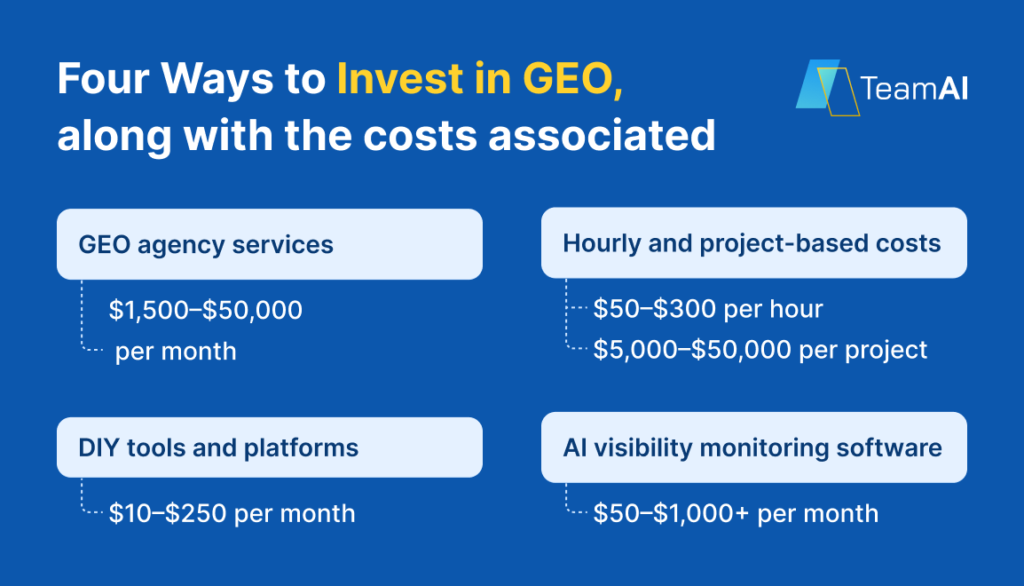
GEO can cost anywhere between $10 and $50,000. The reason for that wide range is that GEO can come with a variety of different costs, depending on your approach. Here are four approaches to GEO, along with the costs associated with them:
GEO agency services
Like many businesses, you may choose to partner with a professional agency for help with your GEO. If so, you can expect to pay between $1,500 and $50,000 per month.
The exact cost of GEO for your business will vary based on your chosen deliverables and the specific agency you partner with. In most cases, agency GEO pricing covers a mix of strategy, content optimization, visibility tracking, and authority-building support.
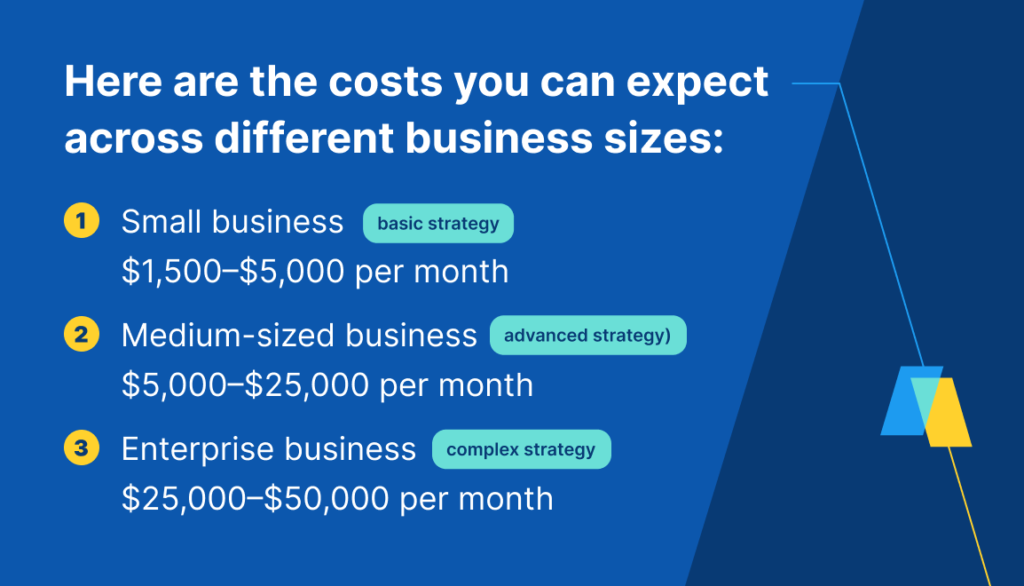
The size of your business and the scope of your GEO strategy will have a particularly large impact, though. Here are the costs you can expect across different business sizes:
- Small business (basic strategy): $1,500–$5,000 per month
- Medium-sized business (advanced strategy): $5,000–$25,000 per month
- Enterprise business (complex strategy): $25,000–$50,000 per month
Even within those narrower ranges, the exact costs will still vary. So, there’s no guarantee that the numbers shown above will reflect the costs your business experiences.
Hourly and project-based costs
Hourly and project-based GEO costs most often run in the range of $50–$300 per hour and $5,000–$50,000 per project.
You’re likely to end up paying these costs if you hire an agency not for full GEO services, but only for GEO consulting, or to help you with one specific project. In that case, you’ll end up paying a lot less than you would for full-blown GEO management, but you’ll also get a lot less out of it — you’ll still have to manage most of your GEO in-house.
Even so, some projects can still cost you up to $50,000, so it’s not always cheap.
DIY tools and platforms
DIY tools and platforms typically cost somewhere in the range of $10–$250 per month.
If you’re handling your GEO strategy in-house, you’ll need the right tools and platforms to support that work. But those tools come with their own costs, which can be broken down into the following ranges:
- Basic AI SEO tools: Free, or $10–$50 per month
- Advanced AI SEO tools: $60–$250+ per month
- Custom enterprise software: Custom pricing (to facilitate a more complex setup process)
Keep in mind that some tools may even cost more than the ranges listed above, depending on which plan you select and how high-end the tool is. The good news is that if you partner with an agency, they’ll likely provide all the tools you need without you needing to worry about those extra costs.
AI visibility monitoring software
AI visibility monitoring software costs tend to fall between $50 and $1,000+ per month.
Having this software is of paramount importance when running your GEO campaigns, because it allows you to track your performance in AI citations. Performance tracking is crucial for improving your GEO campaigns over time and driving better results.
Here are the price ranges for some of the most popular AI visibility software options:
- Semrush: $165.17–$455.67 per month
- OmniSEO®: $89–$899+ per month
- Surfer SEO: $79–$999+ per month
- AirOps: Custom pricing
Factors impacting the cost of GEO
The exact amount that you spend on your GEO strategy depends on several factors. Some of the most significant ones include:
- GEO strategy scope: The size of your GEO strategy — including the number of pages you optimize and the specific goals you have — will have a big impact on your overall GEO costs.
- Professional agency partnership: If you partner with a professional GEO agency, your GEO pricing will depend on which agency you choose and which of their pricing packages you select.
- In-house GEO management: You might choose to manage all of your GEO efforts in-house rather than partner with an agency. If so, you’ll have to budget for hiring a dedicated GEO team and purchasing all the necessary software.
- Tools and software: The specific tools you use to help with your GEO, as well as the pricing plans you opt for, will have a significant impact on your GEO costs.
What’s included in GEO costs?
GEO costs cover a range of deliverables. Many of those deliverables are the same as those in traditional SEO, but you also get features like:
- AI-focused keyword research
- AI optimization website audits
- Optimization for FAQs and featured snippets
- Content formatting optimized for LLMs
Putting those deliverables together with agency costs and specific software helps provide context to why GEO costs what it does.
How to choose the right GEO solution for your budget
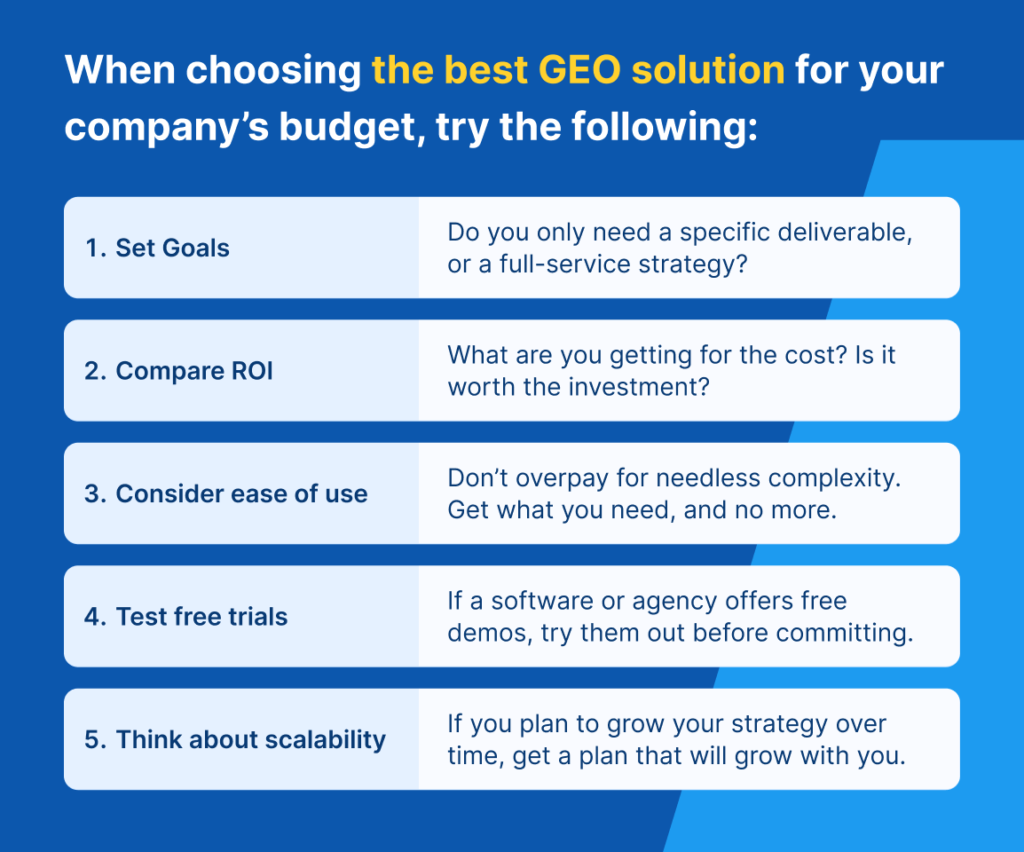
When choosing the best GEO solution for your company’s budget, try the following:
- Set goals: Do you only need a specific deliverable, or a full-service strategy?
- Compare ROI: What are you getting for the cost? Is it worth the investment?
- Consider ease of use: Don’t overpay for needless complexity. Get what you need, and no more.
- Test free trials: If a software or agency offers free demos, try them out before committing.
- Think about scalability: If you plan to grow your strategy over time, get a plan that will grow with you.
Each of these considerations will help you find the right plan without overspending or undercommitting.
Why GEO costs vary so widely
GEO costs vary as much as they do because unlike SEO, GEO is still an emerging service, which means it’s also less standardized. As a result, what you’re paying for can look very different from one provider to another.
Not only do the scope of GEO campaigns vary immensely, but the specific technology you use matters, too. Proprietary platforms may cost more than basic tools — unless you’re accessing them through a professional agency, but that agency will have its own costs, which adds even more variation.
The bottom line is, GEO pricing varies because it requires you to choose between so many different options in so many different areas.
Methodology
When identifying the price ranges associated with GEO, we looked at industry benchmark research we conducted in 2026, as well as publicly available provider pricing and GEO agency pricing data.
Keep in mind that due to the highly customizable nature of GEO services, the actual prices you experience may vary greatly. Use the ranges on this page only as planning estimates, as opposed to exact quotes.
GEO pricing FAQs
Below are the answers to some of the most common GEO pricing FAQs.
What is GEO?
GEO stands for generative engine optimization. It’s a digital marketing strategy where businesses optimize their website content to appear in relevant generative AI responses so that users will discover their brands there. The goal is to get cited in AI tools like ChatGPT, AI Overviews, Perplexity, and other answer engines.
Is it more cost-effective to do GEO in-house or with an agency?
It depends on the specifics of your budget and strategy, so there may be cases where an in-house approach is more cost-effective. But in most cases, an agency is going to cost less. That’s because when you hire an agency, you get immediate access to a ready-made team of GEO experts who are already equipped with all the necessary tools.
How much does GEO cost for multi-location companies?
How much does GEO cost for multi-location companies?
The GEO pricing range for multi-location companies is more or less the same as the overall range. However, it does tend to err on the higher side of that range for companies with multiple locations. That’s because you may have to manage separate GEO campaigns for each location, optimizing across different pages and for different search intents.
Can I do GEO on my own?
Yes. But if you choose to manage GEO on your own, it means you’ll have to hire a dedicated team to work on it, and you’ll have to buy all the necessary software yourself. Plus, you’ll have to set aside the time to work on your GEO campaigns. It’s often more advantageous to hire an agency, where you’ll get all of those things for an overall lower cost (and with a lot less effort on your part).
Get your AI optimization strategy off the ground with WebFX
Understanding GEO costs is the first step. From there, your team can decide which tools, workflows, and level of support make the most sense for your goals. If you want expert help building and managing your strategy, partnering with an experienced agency can make it easier to move forward with confidence.
WebFX combines fresh data with decades of digital marketing experience to help businesses build GEO strategies that improve visibility in AI search results and support long-term growth.
Interested in partnering with WebFX? Contact them online to get started with their GEO services today!