

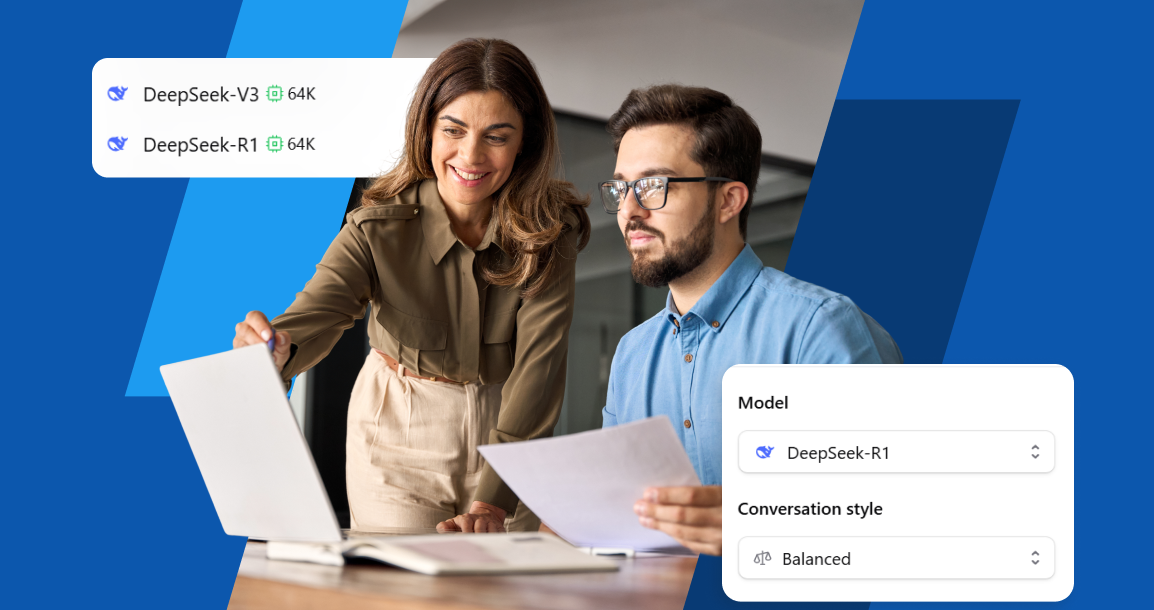
DeepSeek is no longer the upstart it was in January 2025. The Hangzhou-based lab has shipped a steady cadence of frontier and near-frontier models since then, capped by the V4 Preview release on April 24, 2026 (V4 Pro and V4 Flash, both with a 1 million token context window). Then, on May 31, 2026, DeepSeek made its 75 percent V4-Pro price discount permanent, pricing output tokens roughly 34 times below GPT-5.5 and 29 times below Claude Opus 4.8.
This guide walks through the complete DeepSeek lineup, what each model is actually good at, how the prices and context windows compare, and how to think about DeepSeek alongside the other frontier providers (OpenAI, Anthropic, Google) for team use.
Quick-reference: DeepSeek models at a glance (June 2026)
DeepSeek Models
Quick reference guide • June 2026
| Model | Total Params | Active Params | Context | Output Price (per 1M tokens) | Best For |
|---|---|---|---|---|---|
| V4-Pro | 1.6T (MoE) | 49B | 1,000,000 | $0.87 | Agentic coding, deep reasoning, long-doc analysis |
| V4-Flash | 284B (MoE) | 13B | 1,000,000 | $0.28 | High-volume APIs, chat, classification |
| V3.2 | MoE + DSA | n/a | 128K (164K ext.) | Legacy | Teams pinning a 128K MoE checkpoint |
| R1 | Dense (V3 backbone) | n/a | 64K | Open weights | Fine-tuning, research, on-prem reasoning |
| R1-Distill-Qwen-32B | Dense | 32B | 164K | Open weights | Single-GPU reasoning deployment |
| DeepSeek-Coder-V2 | MoE (V2 backbone) | n/a | 128K | Open weights | IDE plugins, local code completion |
No models match your search criteria.
All models listed above carry MIT-licensed open weights available on Hugging Face. Pricing sourced from the DeepSeek API pricing page as of June 2, 2026.
What is DeepSeek?
DeepSeek is a Chinese AI research lab founded in 2023 by Liang Wenfeng that develops open-weight large language models under the MIT license. The lab spun out as an independent company in July 2023 from the AI hedge fund High-Flyer and shipped its first public model (DeepSeek Coder) in November 2023.
DeepSeek became globally well known in January 2025, when the release of DeepSeek-R1 triggered what Marc Andreessen described as “AI’s Sputnik moment”. R1 matched OpenAI o1 on several reasoning benchmarks at a fraction of the training cost: DeepSeek’s published technical report estimated $5.6M of training compute for the underlying V3 model, and R1’s reinforcement learning stage was later disclosed at $294,000. The mobile app launch that month briefly knocked Nvidia and other AI infrastructure stocks down by hundreds of billions of dollars in market cap.
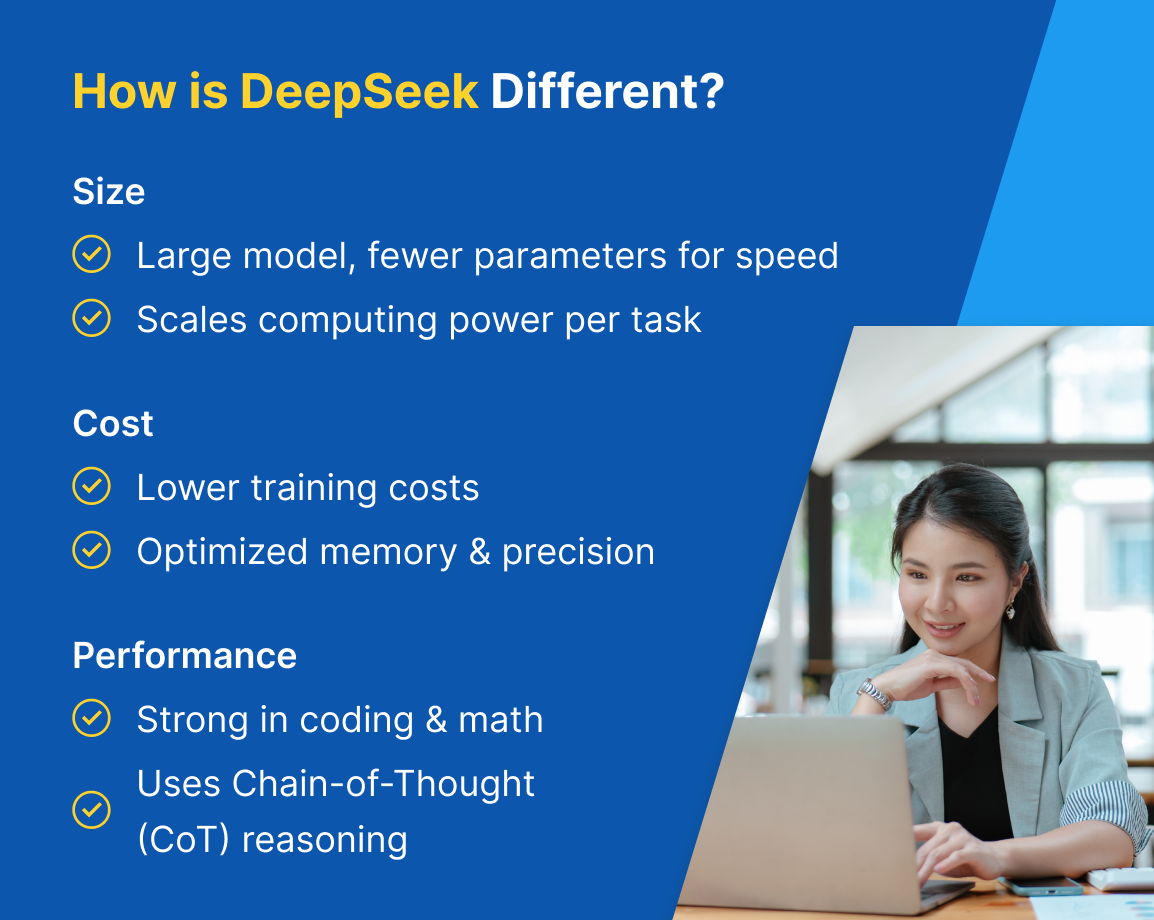
Three things still set DeepSeek apart from OpenAI, Anthropic, and Google:
- Open weights, MIT licensed. Every model from V3 forward ships under MIT. You can download the weights from Hugging Face, fine-tune them, host them on your own infrastructure, or build commercial products on top.
- Mixture-of-Experts efficiency. DeepSeek models activate only a fraction of total parameters per token (V4-Pro: 49B of 1.6T active; V4-Flash: 13B of 284B active). That keeps inference cheap and fast even as total capacity scales.
- Price discipline. DeepSeek consistently undercuts US providers by 10x or more on API pricing. The May 2026 V4-Pro permanent discount made that gap the new normal.
DeepSeek’s current model lineup (2026)
DeepSeek’s official API now lists two primary model IDs, with several previous-generation and specialized models still available either through the API or as open-weight downloads from Hugging Face.
DeepSeek-V4-Pro Current Flagship
Released April 24, 2026
Per DeepSeek’s official release notes
| Property | Value |
|---|---|
| Total parameters | 1.6 trillion (Mixture-of-Experts) |
| Active parameters per token | 49 billion |
| Context window | 1,000,000 tokens |
| Max output tokens | 384,000 |
| Reasoning modes | Non-Thinking, Thinking High, Thinking Max |
| API model ID | deepseek-v4-pro |
| Input pricing (cache miss) | $0.435 per 1M tokens |
| Input pricing (cache hit) | $0.003625 per 1M tokens |
| Output pricing | $0.87 per 1M tokens |
| License | MIT (open weights) |
No specifications match your search criteria.
V4-Pro is designed for complex reasoning, agentic coding, and long-context analytical work. Its architecture pairs token-wise compression with DeepSeek Sparse Attention (DSA, first introduced in V3.2-Exp) to keep both memory and compute costs manageable at the 1M-token scale. The three reasoning effort modes let you tune the thinking budget per request rather than maintaining separate model deployments.
When to choose V4-Pro: complex coding, multi-step agents, deep research across long documents, math and science reasoning, or any task you would currently route to GPT-5.5 Thinking or Claude Opus 4.8.
DeepSeek-V4-Flash Cost-Efficient
The lightweight sibling
Also released April 24, 2026
| Property | Value |
|---|---|
| Total parameters | 284 billion (Mixture-of-Experts) |
| Active parameters per token | 13 billion |
| Context window | 1,000,000 tokens |
| Max output tokens | 384,000 |
| Reasoning modes | Non-Thinking, Thinking High, Thinking Max |
| API model ID | deepseek-v4-flash |
| Input pricing (cache miss) | $0.14 per 1M tokens |
| Input pricing (cache hit) | $0.0028 per 1M tokens |
| Output pricing | $0.28 per 1M tokens |
| License | MIT (open weights) |
No specifications match your search criteria.
V4-Flash trades some reasoning depth for throughput and cost. It still shares the 1M context window and the same API surface as V4-Pro, so you can switch between them with a single parameter change.
When to choose V4-Flash: high-volume API workloads (customer support, classification, bulk document summarization, content moderation), tier-one chat assistants, or anywhere you would currently route to GPT-5.5 mini or Claude Sonnet 4.6.
Previous generation, still available: DeepSeek-V3.2
DeepSeek-V3.2 was the December 2025 flagship before V4 shipped. It remains available through both the API and as open weights for teams that want to compare or pin a specific generation.
| Property | Value |
|---|---|
| Architecture | MoE with DeepSeek Sparse Attention (DSA, introduced in V3.2-Exp) |
| Context window | 128K default, 164K extended |
| Variants | V3.2, V3.2-Speciale (agentic variant) |
| License | MIT |
V3.2 is the model that introduced Sparse Attention, the architectural change that made the V4 1M-token default economically viable. It is no longer the recommended default for new projects, but it offers a meaningful step up from V3 and V3.1 for teams that specifically want a 128K context MoE with a more conservative cost profile.
The reasoning model: DeepSeek-R1
DeepSeek-R1 is the model that put DeepSeek on the global map. Released January 20, 2025, it was the first widely available open-weight model to demonstrate that chain-of-thought reasoning can emerge from reinforcement learning on verifiable tasks rather than requiring supervised fine-tuning. The R1-0528 update in May 2025 improved math and code reasoning further.
As of June 2026, DeepSeek-R2 has not shipped. Treat any R2 release claims as rumors unless DeepSeek publishes an official model card.
| Property | Value |
|---|---|
| Architecture | Reasoning-tuned model based on V3 backbone |
| Context window | 64K (original); R1-0528 extends to 164K |
| Training | Reinforcement learning on verifiable tasks (math, code) |
| Technical report | arXiv:2501.12948 |
| License | MIT |
When to choose R1 in 2026: if you have an existing R1 deployment, if you need to fine-tune a reasoning model on your own infrastructure, or if you want a stable, well-studied checkpoint for research. For new production workloads, V4-Pro with Thinking Max mode is generally a stronger and cheaper choice. See also: How to Choose the Right LLM for Your Business in 2026.
The distilled models: R1-Distill family
After R1 launched, DeepSeek released a set of smaller dense models distilled from R1's reasoning traces. These are useful when you need to run on-device or on smaller GPU hardware.
R1 Distilled Models Open Weights
Reasoning capability distilled into smaller Qwen & Llama backbones
| Model | Base architecture | Parameters | Context |
|---|---|---|---|
| R1-Distill-Qwen-1.5B | Qwen2.5 | 1.5B | 33K |
| R1-Distill-Qwen-7B | Qwen2.5 | 7B | 164K |
| R1-Distill-Qwen-14B | Qwen2.5 | 14B | 164K |
| R1-Distill-Qwen-32B | Qwen2.5 | 32B | 164K |
| R1-Distill-Llama-8B | Llama 3.1 | 8B | 164K |
| R1-Distill-Llama-70B | Llama 3.3 | 70B | 164K |
| R1-0528-Qwen3-8B | Qwen3 | 8B | 164K |
No models match your search criteria.
All distilled models are available at huggingface.co/deepseek-ai under MIT license.
When to choose a distilled model: edge deployments, single-GPU inference, regulatory environments requiring on-premises hosting, research, or when you want a small open-weight reasoning model to fine-tune on your own data.
Specialty line: DeepSeek-Coder
DeepSeek's code-specialized model family predates the V series. The two notable releases are:
- DeepSeek-Coder (November 2023): the original code-focused model. Available in dense sizes from 1.3B to 33B.
- DeepSeek-Coder-V2 (June 2024): built on the V2 MoE backbone, supports 338 programming languages, 128K context.
In 2026, for most coding workloads V4-Pro or V4-Flash (both strong on code) are the better defaults. The Coder line remains relevant for teams that want a smaller dedicated code model for IDE plugins or local inference on consumer hardware.
How DeepSeek compares to the other frontier providers
The most useful comparison for teams evaluating providers is the four-way view: DeepSeek, OpenAI (GPT-5.5 family), Anthropic (Claude Opus 4.8), and Google (Gemini 3.1 Pro).
DeepSeek vs ChatGPT (GPT-5.5): the cost gap in plain numbers
DeepSeek V4-Pro and ChatGPT (GPT-5.5) are the two most commonly compared frontier models in 2026, and the cost difference is significant enough to change architectural decisions at scale.
As of June 2026 per official provider pricing pages:
| DeepSeek V4-Pro | GPT-5.5 | |
|---|---|---|
| Input (per 1M tokens) | $0.435 | $5.00 |
| Output (per 1M tokens) | $0.87 | $30.00 |
| Context window | 1,000,000 | 128K standard (272K long-context) |
| Open weights | Yes (MIT) | No |
| Reasoning modes | Non-Thinking / Thinking High / Thinking Max | Standard / Thinking |
On output tokens, V4-Pro is roughly 34 times cheaper than GPT-5.5. At 10 million output tokens per month (a moderate enterprise API workload), that is the difference between an $8,700 monthly bill and a $300,000 monthly bill.
The tradeoff: GPT-5.5 retains a consistent edge on the most demanding agentic and tool-use benchmarks, has a substantially more mature SDK and plugin ecosystem, and data processed through OpenAI's API stays within established US-based infrastructure. For teams in regulated industries or those deeply embedded in the OpenAI toolchain, that ecosystem value may outweigh the cost gap.
For teams with cost-sensitive API workloads, unregulated data, and no strong ecosystem lock-in, V4-Pro is the strongest challenger to GPT-5.5 currently available. See: Why You Should Use Multiple Large Language Models for how to run both in parallel.
Pricing comparison across all four major providers (June 2026)
Pricing sourced directly from provider documentation as of June 2, 2026. Verify current rates before purchasing.
| Model | Input (per 1M tokens) | Output (per 1M tokens) | Notes |
|---|---|---|---|
| DeepSeek V4-Pro | $0.435 | $0.87 | Permanent post-promo pricing as of 2026-05-31 |
| DeepSeek V4-Flash | $0.14 | $0.28 | |
| GPT-5.5 | $5.00 | $30.00 | Long-context tier (>272K) is $10 / $45 |
| Claude Opus 4.8 | $5.00 | $25.00 | Standard tier |
| Gemini 3.1 Pro | $1.25 | $10.00 | Deep Think mode billed separately |
On output tokens: V4-Pro is approximately 34x cheaper than GPT-5.5, 29x cheaper than Claude Opus 4.8, and 11.5x cheaper than Gemini 3.1 Pro. That cost gap has made DeepSeek part of the active evaluation for nearly every enterprise AI buyer in 2026.
Reasoning, coding, and general capability
For most public benchmarks (MMLU, GPQA, HumanEval, SWE-Bench, AIME), V4-Pro lands within striking distance of GPT-5.5 and Claude Opus 4.8. The exact ranking depends on the benchmark and the reasoning mode used.
A gap does still exist on the most demanding agentic and tool-use tasks, where GPT-5.5 and Claude Opus 4.8 retain a small but consistent edge. For straightforward chat, coding, analysis, and long-context work, V4-Pro is competitive at a fraction of the cost. For a detailed benchmark-by-benchmark breakdown, see 22 AI Frontier Models Compared for 2026.
Tradeoffs to think through before switching
Data jurisdiction. Using the official DeepSeek API routes traffic to servers in China. For regulated industries (healthcare, financial services, government), this is often a non-starter. The MIT-licensed open weights solve this: many enterprises that want DeepSeek's cost profile run the models on their own infrastructure or through Western hosting providers like Fireworks, Together, and DeepInfra that host the weights in US and EU regions.
Tooling and ecosystem maturity. OpenAI, Anthropic, and Google have substantially more mature SDKs, IDE integrations, evaluation tooling, and enterprise support. DeepSeek's open weights have strong day-zero support from vLLM, SGLang, and Hugging Face TGI, but the surrounding toolchain is thinner.
Reasoning effort calibration. The three thinking modes (Non-Thinking, Thinking High, Thinking Max) give precise cost control, but they require tuning per workload. Teams accustomed to picking a model and calling it will need to add reasoning-effort selection to their stack.
Which DeepSeek model should you use?
A plain-English decision table for the most common 2026 use cases.
| Use case | Recommended model | Reasoning mode | Why |
|---|---|---|---|
| Customer support assistant, high volume | V4-Flash | Non-Thinking | Cheapest option that handles the bulk of tier-one chat |
| Coding copilot, real-time | V4-Flash | Thinking High | Good code quality at low latency and cost |
| Agentic coding (multi-step, repo-wide) | V4-Pro | Thinking Max | Closest open-weight competitor to GPT-5.5 Thinking and Claude Opus 4.8 on agentic tasks |
| Long-document analysis (legal contracts, research papers) | V4-Pro | Non-Thinking or Thinking High | The 1M context plus DSA architecture is DeepSeek's strongest differentiator here |
| Research, fine-tuning, edge deployment | R1-Distill-Qwen-32B or similar | n/a | Small open-weight reasoning models you can fine-tune on a single H100 |
| Math, science, formal reasoning | V4-Pro | Thinking Max | Benchmarks best on modern reasoning evals; R1 for legacy compatibility |
| IDE plugin (local inference) | DeepSeek-Coder-V2 16B Lite | n/a | Dedicated code model that fits on consumer hardware |
For guidance on choosing between DeepSeek and other providers across different team workflows, see How to Choose the Right LLM for Your Business in 2026.
DeepSeek in a multi-model team workflow
Most teams in 2026 do not pick a single AI provider. They route the right model to the right job. A typical stack might look like:
- GPT-5.5 for general team chat and product integrations where ChatGPT habits matter
- Claude Opus 4.8 for long-form writing, contract analysis, and customer-facing copy
- Gemini 3.1 Pro for multimodal workflows (image, video, audio) and Google Workspace integration
- DeepSeek V4-Pro or V4-Flash for high-volume API workloads, agentic coding, and any cost-sensitive task that does not have data-jurisdiction concerns
The operational challenge is real. Running four providers means four billing accounts, four API keys, four context formats, four sets of safety and access controls, and four places where prompt-library work disappears into individual accounts. Why Your Team Needs a Unified AI Workspace covers this problem in depth.
TeamAI brings DeepSeek, GPT-5.5, Claude, Gemini, and the other major frontier models into one workspace with shared prompt libraries, custom agents, team-wide access controls, and a single billing surface. Your team picks the right model for each task without re-configuring the stack every time DeepSeek ships a price cut or OpenAI ships a new flagship.
Related reading: Why You Should Use Multiple Large Language Models · Why Your Team Needs a Unified AI Workspace · How to Choose the Right LLM for Your Business in 2026 · 22 AI Frontier Models Compared for 2026
Frequently asked questions
What is the latest DeepSeek model?
The latest DeepSeek model as of June 2026 is DeepSeek V4 Pro, released April 24, 2026. It is an open-weight Mixture-of-Experts model with 1.6 trillion total parameters (49 billion active per token) and a 1 million token context window. DeepSeek also released V4 Flash alongside it: a lighter 284B / 13B active sibling with the same context window and API surface. DeepSeek-R2 has not shipped as of June 2026; treat any R2 claims as rumors until DeepSeek publishes an official model card.
How much does DeepSeek V4 Pro cost?
As of June 2, 2026, DeepSeek V4-Pro is priced at $0.435 per million input tokens (cache miss), $0.003625 per million input tokens (cache hit), and $0.87 per million output tokens. These rates became the permanent list prices on May 31, 2026, after DeepSeek made its 75 percent promotional discount permanent. That is roughly 11.5 times cheaper than GPT-5.5 on input and 34 times cheaper on output. Verify current rates at the DeepSeek API pricing page.
What is the difference between DeepSeek V4 Pro and V4 Flash?
V4-Pro is the flagship: 1.6 trillion total parameters with 49 billion active per token, designed for complex reasoning, agentic coding, and analytical work. V4-Flash is the efficiency variant: 284 billion total parameters with 13 billion active, optimized for high-throughput, low-cost workloads. Both share the same 1 million token context window, the same three reasoning modes (Non-Thinking, Thinking High, Thinking Max), and the same API surface. The choice comes down to whether you need V4-Pro's reasoning depth or V4-Flash's lower per-token cost.
Is DeepSeek open source?
Yes. All current DeepSeek models (V4-Pro, V4-Flash, V3.2, V3.1, R1, R1-Distill family) ship with both code and model weights under the MIT license, available on Hugging Face. Some older releases (V3 base, Coder-V2, VL2) split MIT-licensed code from a separate DeepSeek Model License for the weights, so always check the specific repository if licensing matters to your use case.
Is DeepSeek as good as GPT-5.5 or Claude Opus 4.8?
On most public benchmarks (MMLU, GPQA, HumanEval, SWE-Bench, AIME), V4-Pro lands within striking distance of GPT-5.5 and Claude Opus 4.8. GPT-5.5 and Claude Opus 4.8 retain a small but consistent edge on the most demanding agentic and tool-use tasks. For straightforward chat, coding, analysis, and long-context work, V4-Pro is competitive at roughly 1/30th the cost on output tokens.
Which DeepSeek model should I use?
For most production API workloads, start with V4-Flash and upgrade to V4-Pro only for tasks that require deeper reasoning (multi-step agents, agentic coding, complex math). For research or on-premises deployment, choose an R1-Distill model sized to your hardware. For IDE plugins or local code completion, DeepSeek-Coder-V2 is still a strong pick. The decision table in the "Which model should you use?" section above covers the most common 2026 scenarios.
What is DeepSeek-R1 used for?
DeepSeek-R1 is a reasoning-first model best suited for math, science, formal logic, and code generation tasks that benefit from explicit chain-of-thought. Released in January 2025, it was the first widely available open-weight model to show that reasoning capability can emerge from reinforcement learning on verifiable tasks rather than supervised fine-tuning. In 2026, R1 is most useful for teams with existing R1 deployments, researchers studying reasoning emergence, and anyone fine-tuning a reasoning model on their own infrastructure. For new production workloads, V4-Pro with Thinking Max mode is generally a stronger and cheaper choice. The original technical report is available at arXiv:2501.12948.
Should businesses trust DeepSeek for production use?
Businesses can deploy DeepSeek for production workloads where data jurisdiction is not restricted. The key constraint is that the official DeepSeek API routes traffic to servers in China, which is a non-starter for regulated industries (healthcare, financial services, government). The MIT-licensed open weights solve this: enterprises that want DeepSeek's cost profile typically run the models on their own infrastructure or through Western hosting providers like Fireworks, Together, and DeepInfra that host the weights in US and EU regions. For unregulated workloads without data-jurisdiction concerns, the official API is competitive and reliable.
Bring DeepSeek and every other frontier model into one workspace
TeamAI gives your team access to DeepSeek V4-Pro, V4-Flash, GPT-5.5, Claude Opus 4.8, Gemini 3.1 Pro, and every other major frontier model in one shared workspace. Shared prompt libraries, custom agents, role-based access controls, and a single billing surface so your team picks the right model for each job without re-configuring the stack every time a new flagship ships.