


AI Guide

agents
How to Build an AI Agent Library: A Powerful Google Agentspace Alternative
AI Automation
Best AI Models for Coding and Agentic Workflows (2026) Best AI Models for Writing, Business Tasks and General Intelligence (2026) Who's Winning the AI Race in 2026? Claude vs ChatGPT vs Gemini in 2026: Giants, Challengers, and the AI model Showdown The 2026 AI Frontier Model War The 2026 AI Frontier Model War How to Set Up AI Automated Workflows
AI Collaboration
Best AI Models for Writing, Business Tasks and General Intelligence (2026) Who's Winning the AI Race in 2026? Claude vs ChatGPT vs Gemini in 2026: Giants, Challengers, and the AI model Showdown The 2026 AI Frontier Model War The 2026 AI Frontier Model War How to Get My Team to Collaborate with ChatGPT
AI for Sales
Generating Sales Role-Play Scenarios with ChatGPT
AI Integration
Who's Winning the AI Race in 2026? Claude vs ChatGPT vs Gemini in 2026: Giants, Challengers, and the AI model Showdown The 2026 AI Frontier Model War The 2026 AI Frontier Model War Integrating Generative AI Tools, like ChatGPT, into Your Team's Operations
AI Processes and Strategy
Best AI Models for Writing, Business Tasks and General Intelligence (2026) How to Safeguard My Business Against Bad AI Use by Employees Providing Quality Assurance and Oversight of AI Like ChatGPT Choosing the Right LLM for the job or use case How to Use ChatGPT & Generative AI to Scale a Team's Impact
Build an AI Agent
Creating a Custom AI Agent for Businesses Creating a Custom AI Marketing Agent Create an AI Agent for Sales Teams
Generative AI and Business
Best AI Models for Writing, Business Tasks and General Intelligence (2026) The Benefits of AI for Small Businesses: Leveling the Playing Field Building a Data-Driven Culture With AI: A Practical Guide for Teams 16 AI Terms Everyone Should Know Top 13 Alternatives to ChatGPT Teams in 2025 Top 7 Large Language Models (LLMs) for Businesses Ranked Will ChatGPT and LLMs Take My Job? Understanding the Value of ChatGPT and LLMs for Teams and Businesses Why Use ChatGPT & Generative AI for My Business
Large Language Models (LLMs)
AI Model Economics: Choosing by Budget and Scale (2026) Best AI Models for Complex Reasoning (2026) Best AI Models for Coding and Agentic Workflows (2026) Best AI Models for Writing, Business Tasks and General Intelligence (2026) Who's Winning the AI Race in 2026? Claude vs ChatGPT vs Gemini in 2026: Giants, Challengers, and the AI model Showdown The 2026 AI Frontier Model War The 2026 AI Frontier Model War Understanding the Different Gemini Models: Their Characteristics and Capabilities Understanding the Different DeepSeek Models: What Makes Them Unique? Understanding Different Claude Models: A Guide to Anthropic’s AI Understanding Different ChatGPT Models: Key Details to Consider Meet the Riskiest AI Models Ranked by Researchers Why You Should Use Multiple Large Language Models Overview of Large Language Models (LLMs)
LLM Pricing
AI Model Economics: Choosing by Budget and Scale (2026)
Prompt Libraries
AI Prompt Templates for HR and Recruiting AI Prompt Templates for Marketers 8-Step Guide to Creating a Prompt for AI  What businesses need to know about prompt engineering How to Build and Refine a Prompt Library

Best AI Models for Writing, Business Tasks and General Intelligence (2026)

This image depicts a modern work environment, showcasing a collage of activities related to remote collaboration and digital communication. On the top left, a woman engages in a video conference with multiple participants, highlighting virtual meetings. The top right and bottom right sections show individuals working on computers in an office setting, with one scene focusing on typing and another on a laptop with a clipboard. The bottom left captures a close-up of hands typing on a laptop, emphasizing focused work. Overlaying these scenes is a screenshot of a digital communication platform, likely Slack, showing a conversation thread with automated messages and requests, indicating task management and integration within a team's workflow. The overall theme is the integration of technology in contemporary work practices, facilitating both remote and in-office collaboration and communication.

GPT-5, Claude 4 Sonnet, Gemini Flash, DeepSeek V3 and more: a practical comparison guide and per-workspace strategy for teams and MSPs.

The reasoning tier gets the headlines. Benchmark scores like 100% AIME 2025 and 92.4% GPQA Diamond are the numbers shared in newsletters and debated on LinkedIn. But if you mapped every AI interaction your team had last week, the vast majority weren’t reasoning tasks.

They were smart tasks:

  • Writing a first draft
  • Summarizing a meeting
  • Replying to a customer
  • Pulling key points from a document
  • Generating social copy from a brief

This is the smart tier, general intelligence work that doesn’t require a model to deliberate for twenty minutes before responding. It’s also where most of your AI spending goes, where your team’s daily productivity either compounds or stalls, and where the wrong default model quietly costs you more than any benchmark comparison would suggest.

This guide covers:

  • The eight models that matter in the smart tier, plus one notable alternative
  • A practical decision framework for choosing between them
  • The per-workspace strategy most teams aren’t running but should be

What Counts as a Smart Task

Smart tasks share a few key characteristics:

  • They’re well-defined with a clear output format
  • They don’t require working through a genuinely novel problem
  • They require fluency, accuracy and speed, not extended deliberation

In practice, smart tasks include:

  • Writing and editing copy across formats
  • Summarizing meetings and documents
  • Answering questions from a knowledge base
  • Generating customer-facing communication
  • Transforming content from one format to another (transcript to blog post, spec sheet to FAQ, call notes to CRM entry)
  • Light analysis, like reading a CSV and flagging what’s worth looking at

Smart tasks are not multi-step reasoning chains, novel mathematical problems, complex code generation, or tasks requiring extended autonomous execution. Those belong in the reasoning and code tiers. The models built for those jobs are slower, more expensive and often overkill for work that makes up the majority of most teams’ AI usage.

Getting your smart tier right matters more than getting your reasoning tier right, because you’re in it all day, every day.
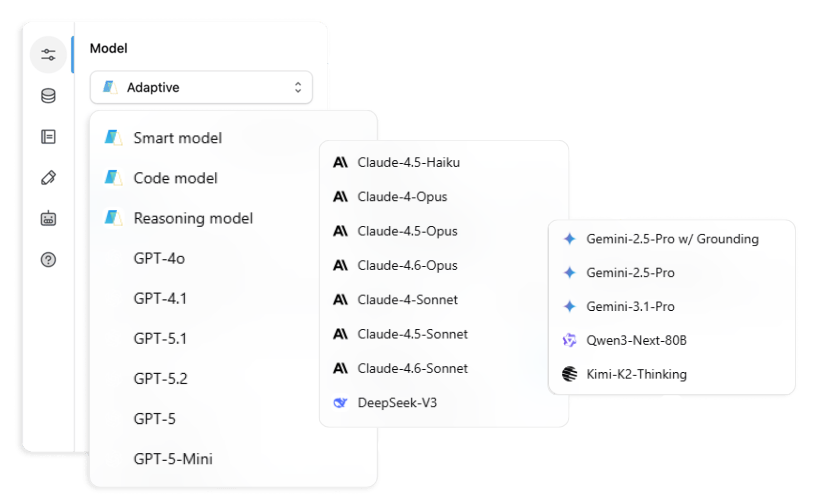
The image displays a user interface for selecting different AI models, categorized into 'Adaptive', 'Smart model', 'Code model', and 'Reasoning model'. A list of specific models is shown, including various versions of GPT (GPT-4o, GPT-4.1, GPT-5.1, GPT-5.2, GPT-5, GPT-5-Mini), Claude (Claude-4.5-Haiku, Claude-4-Opus, Claude-4.5-Opus, Claude-4.6-Opus, Claude-4-Sonnet, Claude-4.5-Sonnet, Claude-4.6-Sonnet), DeepSeek-V3, Gemini (Gemini-2.5-Pro w/ Grounding, Gemini-2.5-Pro, Gemini-3.1-Pro), Qwen3-Next-80B, and Kimi-K2-Thinking. The interface suggests a system where users can choose the AI model best suited for their task.

Quick Comparison: All 8 Models at a Glance

ModelInput ($/M tokens)Output ($/M tokens)Context WindowBest For
GPT-5.1$1.25$10.00400KBrand voice, customer-facing copy
GPT-5 mini$0.25$2.00400KHigh-volume drafts, automated pipelines
GPT-5 nano$0.05$0.40400KClassification, routing, edge deployments
Claude 4.6 Sonnet$3.00$15.001M (beta)Complex docs, multi-constraint tasks
Claude 4.5 Haiku$1.00$5.00200KVolume tasks, Anthropic-native workflows
Gemini 2.5 Flash$0.30$2.501MReal-time generation, high-speed pipelines
Gemini 2.5 Pro + Grounding$1.25$10.001MLive intelligence, competitive research
DeepSeek V3$0.27 (API) / Free (self-hosted)$1.10128KBudget deployments, data sovereignty

Pricing and specifications current as of March 2026. Verify with providers before production deployment.

The Contenders

GPT-5.1 Review: OpenAI’s Best AI Model for Writing and Brand Voice

1.25/1.25/10.00 per million tokens · 400K context

Model review

GPT-5.1

$1.25 / $1.25 / $10.00 per million tokens · 400K context

GPT-5.1 is tuned for natural, conversational output—copy that reads less like generic AI and more like a thoughtful human first draft. Next to the unified GPT-5 release, it’s the most practical OpenAI default in 2026 when tone and brand voice matter as much as factual accuracy.

  • 400K context — long briefs, style guides, and reference docs stay in-frame without constant chunking.
  • Adaptive reasoning — more deliberate answers on harder questions without full reasoning-model cost or latency.
  • Mid-tier pricing — sits above Flash or DeepSeek V3, but the premium pays off for tone-sensitive, customer-facing work.
Best for

Brand voice consistency, customer-facing copy, Slack-integrated workflows, and anywhere tone matters as much as content accuracy.


GPT-5 mini Review: The Best AI Model for High-Volume Content Generation

0.25/0.25/2.00 per million tokens · 400K context

Model review

GPT-5 mini

$0.25 / $0.25 / $2.00 per million tokens · 400K context

GPT-5 mini is the engine behind anything running at scale. At $0.25/M input, it’s one-fifth the cost of GPT-5.1.

  • First drafts of social variations
  • Bulk email generation
  • Automated content pipelines where a human reviews before anything goes out

The teams using this well run mini for volume passes and route to GPT-5.1 for final polish or anything customer-facing. The two-tier approach cuts costs meaningfully without a noticeable drop in final output quality.

The question on any given task is whether the quality delta between mini and 5.1 justifies the 5x price difference. For most first-draft and high-volume use cases, it doesn’t.

Best for

High-volume first drafts, automated content pipelines, bulk variation generation, any workflow with a human review stage.


GPT-5 nano Review: Classification, Routing and Edge Deployments

0.05/0.05/0.40 per million tokens · 400K context

Model review

GPT-5 nano

$0.05 / $0.05 / $0.40 per million tokens · 400K context

At $0.05/M, nano sits in a different economic category entirely. It’s not competing on writing quality.

  • Structured classification
  • Routing decisions
  • Categorization
  • Lightweight tasks that run at a scale where even mini’s cost starts to compound

For MSPs running AI-enhanced triage workflows across dozens of client workloads simultaneously, nano is the right model for the lightweight layer of the stack. It’s easy to underestimate how useful a very cheap, reasonably capable model is in an orchestrated multi-step pipeline where not every step requires the same quality threshold.

Best for

Classification, routing logic, structured extraction, high-frequency lightweight tasks, edge deployments.


Claude 4.6 Sonnet Review: Anthropic’s Best AI Model for Complex Business Tasks

3.00/3.00/15.00 per million tokens · 1M context (beta)

Model review

Claude 4.6 Sonnet

$3.00 / $3.00 / $15.00 per million tokens · 1M context (beta)

Claude 4.6 Sonnet is Anthropic’s recommended starting point for most new integrations and the current default across their platform. In internal evaluations, 70% of users preferred it over the previous generation Claude 4.5 Sonnet.

  • 1M context window — the largest available for a general-purpose model at this price tier (in beta, functional for most document-heavy workflows)
  • Handles complex multi-constraint instructions well
  • Maintains quality across tens of thousands of tokens, not just the first paragraph
  • Strong nuance and judgment for outputs that need to be both accurate and carefully worded

It’s more expensive than GPT-5 mid-tier options. For simple high-volume creative tasks, that premium isn’t always justified. But for complex source material, detailed briefs, technical documentation, long RFPs and knowledge-base synthesis, it earns the cost.

Best for

Document synthesis, complex multi-constraint tasks, long-context work, any output requiring careful judgment alongside accuracy.


Claude 4.5 Haiku Review: High-Quality Budget Option from Anthropic

~1.00/1.00/5.00 per million tokens · 200K context

Model review

Claude 4.5 Haiku

~$1.00 / $1.00 / $5.00 per million tokens · 200K context

Claude 4.5 Haiku delivers approximately 90% of Claude 4.6 Sonnet’s output quality at roughly a third of the price.

  • Route standard volume requests through Haiku
  • Escalate quality-critical or edge-case outputs to Sonnet
  • Most support teams don’t need the premium model on every ticket—they need it on the right ones

The 200K context limit is the main constraint relative to Sonnet’s 1M window. For documents that fit within that threshold, Haiku is the better economic choice for most tasks. This tiering is underused and consistently undervalued by teams who set a single model and leave it there.

Best for

Volume tasks in Anthropic-native workflows, support queues, and tiered routing—reserving Sonnet for the tickets and outputs that actually need it.


Gemini 2.5 Flash Review: The Fastest AI Model for Real-Time Workflows

0.30/0.30/2.50 per million tokens · 232 tokens/sec · 1M context

Model review

Gemini 2.5 Flash

$0.30 / $0.30 / $2.50 per million tokens · 232 tokens/sec · 1M context

At 232 tokens per second, Gemini 2.5 Flash is the fastest widely-available production model. No other model in this tier gets close.

  • 1M context window paired with $0.30/M input pricing means the cost question almost disappears for most use cases
  • Native multimodal support handles images, documents and audio without configuration overhead
  • Ideal for MSPs running AI workflows across multiple simultaneous client environments

It doesn’t win on tone sensitivity or subtle judgment. But for the significant portion of smart tasks where those qualities are secondary to speed and cost, it’s the most practical option available.

Best for

High-speed workflows, real-time generation, simultaneous multi-client deployments, any task where latency is a hard constraint.


Gemini 2.5 Pro + Grounding Review: Live Intelligence for Competitive Research

1.25/1.25/10.00 per million tokens · 1M context

Model review

Gemini 2.5 Pro + Grounding

$1.25 / $1.25 / $10.00 per million tokens · 1M context

The Grounding variant adds live Google Search integration. The model pulls real-time web data as part of generating its response.

  • Every other model in this guide is working from training data with a knowledge cutoff
  • Gemini 2.5 Pro + Grounding is working from what’s online today
  • A competitive monitoring agent built on Grounding can analyze a competitor’s new pricing page, recent press releases and LinkedIn announcements from this week, not this quarter

For marketing teams running competitive intelligence workflows, this changes what’s possible. For any workflow that depends on current information, this is the most important capability distinction in the smart tier.

Best for

Competitive intelligence, market research, any agent or workflow requiring information beyond the model’s training cutoff.


DeepSeek V3 Review: Best Open-Source AI Model for Budget and Self-Hosted Deployments

0.27/0.27/1.10 per million tokens via API · Free self-hosted · 128K context · MIT license

Model review

DeepSeek V3

$0.27 / $0.27 / $1.10 per million tokens via API · Free self-hosted · 128K context · MIT license

DeepSeek V3 is the most cost-competitive capable option in the smart tier.

  • MIT licensed, meaning full commercial use, fine-tuning and self-hosting with no licensing fees
  • 685-billion parameter mixture-of-experts architecture activates only 37 billion parameters per inference pass, delivering frontier-quality outputs at commodity pricing
  • The 128K context window is the main limitation relative to other options here; it works for the majority of smart tasks but rules out very long documents

For organizations where data cannot leave internal infrastructure, self-hosted DeepSeek V3 is currently the strongest argument for capable general AI without cloud dependency.

Best for

Budget-constrained deployments, self-hosting for data sovereignty, regulated-industry clients, high-volume tasks where 128K context is sufficient.


Also Worth Noting: Qwen3 Next 80B

For regulated-industry or government deployments requiring on-premise hosting, Qwen3 Next 80B is an alternative to DeepSeek V3. It offers comparable self-hosted capability with a similar open-weight architecture. It’s not covered in depth in this guide, but if your sovereignty requirements rule out all cloud-hosted options, it’s worth evaluating alongside DeepSeek V3.


A man with a beard and a gray suit jacket smiles enthusiastically while looking at a laptop, with a confirmation checklist displayed on a screen to his right. The checklist details various items related to content intelligence requests, such as AI models, pricing plans, and integrations, all marked as confirmed.

How to Choose: 6 Questions to Find the Right Model

These six questions will narrow the field faster than any feature matrix.

Decision guide

How to Choose: 6 Questions to Find the Right Model

These six questions will narrow the field faster than any feature matrix.

  1. Does tone and brand voice matter for this output?

    If yes, the output is customer-facing, carries your brand, or will be published with minimal editing, start with GPT-5.1 or Claude 4.6 Sonnet. Both produce outputs that require less editing to reach publishable quality. If tone is secondary, the lower-cost options are almost always sufficient.

  2. Is speed a hard constraint?

    If you’re generating outputs in real time, live chat, instant responses, high-frequency pipelines, Gemini 2.5 Flash at 232 tokens per second is a category of its own.

  3. Do you need information that’s current today?

    If the task requires anything beyond the model’s training cutoff, competitor analysis, market conditions, recent announcements, only Gemini 2.5 Pro + Grounding serves that need natively.

  4. Does the data need to stay on-premise?

    For regulated industries, healthcare, legal and government: self-hosted DeepSeek V3 or Qwen3 Next 80B. There is no cloud-hosted workaround for a hard sovereignty requirement.

  5. What’s the volume?

    For thousands of outputs per week, the cost difference between GPT-5.1 and GPT-5 mini or Gemini Flash is significant enough to warrant a tiered approach. For lower-volume, quality-critical work, pay the premium.

  6. How long is your typical document or context?

    Over 200K tokens reliably, you need Claude 4.6 Sonnet, Gemini 2.5 Flash or Gemini 2.5 Pro + Grounding. Under that threshold, the field is wide open.


The Per-Workspace Strategy

Most teams leave real productivity and cost savings on the table, not in their model selection, but in their model uniformity.

One model, set as the global default, applied identically to every workflow, every team, every use case. It’s the path of least resistance and it’s consistently suboptimal. The cost difference between a thoughtful per-workspace model policy and a universal default is often 40 to 60% on inference spend.

A per-workspace model strategy means matching the default to the job of the workspace, not the preference of whoever configured it last.

Here’s what it looks like in practice:

Brand and content workspace: GPT-5.1 as default

  • The tone-sensitivity justifies the $1.25/M input cost over mini
  • Writers get better first drafts, editors make fewer changes
  • The workflow runs faster even though the model is more expensive, because fewer revision cycles means less total time spent

Support and customer communication workspace: Claude 4.5 Haiku for volume, Claude 4.6 Sonnet for escalations

  • Haiku handles the standard queue at a third of Sonnet’s price
  • Sonnet handles complex or sensitive cases where nuanced judgment matters
  • Most support teams don’t need the premium model on every ticket, they need it on the right ones

Competitive intelligence workspace: Gemini 2.5 Pro + Grounding exclusively

  • Without live search, you’re analyzing the market as it existed at the model’s training cutoff
  • With it, you’re analyzing the market as it exists this week
  • For competitive monitoring, this distinction is the entire value of the workflow

High-volume automation workspace: Gemini Flash or GPT-5 mini

  • These outputs feed into other processes and aren’t customer-facing
  • Speed and cost are the metrics that matter, not polish

For MSPs: per-client workspace configuration

  • A law firm client gets a different model default than a DTC ecommerce client
  • The law firm may require self-hosted DeepSeek V3 for data sovereignty
  • The DTC brand needs Flash for high-volume social generation and GPT-5.1 for brand-voice content
  • A single model policy across all client workspaces is the wrong architecture, not because any individual model is inadequate, but because the clients are different

The quality difference, measured in editing time and revision cycles, is harder to quantify but consistently real.


Putting It Together

The smart tier isn’t glamorous. It doesn’t generate benchmark headlines or launch-day coverage. But it’s where the compounding value of AI in a business actually lives:

  • The daily drafts that go out faster
  • The weekly summaries that take minutes instead of an hour
  • The customer replies that require less editing
  • The competitive brief that gets to the team before the window closes

Choosing the right model for the right task, and configuring it consistently across the workspaces where that work happens, is the operational discipline that separates teams running AI as a productivity multiplier from teams running it as a slightly better search engine.

Most teams don’t want to revisit this decision every quarter or manage a spreadsheet of model-to-task mappings. TeamAI is built for exactly this. You set the model policy per workspace once, and the routing, cost controls and usage alerts run from there. The free plan is a reasonable place to start. Most teams that configure even one workspace properly find the logic extends naturally to the rest.

Get started with TeamAI →

Frequently Asked Questions

Which AI model is best for writing in 2026?

GPT-5.1 is the top choice for writing tasks where tone and brand voice matter. It produces copy that requires less editing to reach publishable quality. For high-volume writing at lower cost, GPT-5 mini is the practical alternative, especially in workflows with a human review stage.

Claude vs GPT: which is better for business?

It depends on the task. GPT-5.1 leads on tone-sensitive writing and conversational copy. Claude 4.6 Sonnet leads on complex, multi-constraint tasks, long documents and outputs requiring careful judgment. For most businesses, the right answer is both, used in different workspaces for different jobs.

What is the best AI for content creation in 2026?

For brand-driven content creation, GPT-5.1 or Claude 4.6 Sonnet. For high-volume content pipelines, GPT-5 mini or Gemini 2.5 Flash. The best model depends on whether you’re optimizing for quality, volume or cost. See the per-workspace strategy section above for how to run both.

What is the cheapest capable AI model?

DeepSeek V3 at $0.27/M input (or free self-hosted) is the most cost-competitive capable option. GPT-5 nano at $0.05/M is cheaper but suited to classification and routing tasks rather than general writing. Gemini 2.5 Flash at $0.30/M is the cheapest option with a 1M context window and production-grade speed.

Can I use different AI models per workspace?

Yes, and you should. A per-workspace model strategy, matching the default model to the job of that workspace rather than using one universal default, typically reduces inference spend by 40 to 60% while improving output quality in tone-sensitive workflows. TeamAI supports per-workspace model configuration out of the box.

Gemini Flash vs GPT-5 mini: which should I use?

Gemini 2.5 Flash is faster (232 tokens per second), cheaper ($0.30/M vs $0.25/M input), and comes with a 1M context window versus 400K. GPT-5 mini has a slight edge on writing quality and may integrate more naturally into existing OpenAI-based workflows. For pure volume and speed, Flash wins. For output quality in OpenAI-native pipelines, mini is the better fit.

What is the best AI model for customer support?

Claude 4.5 Haiku for standard volume tickets, Claude 4.6 Sonnet for complex or sensitive escalations. This tiered approach captures roughly 90% of Sonnet’s quality on most tickets at a third of the cost. Running Sonnet on every ticket is unnecessary and expensive for most support teams.

Is DeepSeek V3 safe to use for business?

DeepSeek V3 is MIT licensed, meaning it can be fully self-hosted with no data leaving your infrastructure. For cloud-hosted API usage, apply the same data handling policies you would to any third-party AI provider. For regulated industries with hard data sovereignty requirements, the self-hosted deployment is the recommended path.